Sanskrit language
Sanskrit (संस्कृतम्) is the language in which the Vedas were revealed and therefore the language in which the Upanishads, the Bhagavadgita, the Brahmasutra and all vedic and allied scriptures have been handed down to us. For the preservation of the Vedas and allied scriptures the grammatical structure of the language was thoroughly studied and set down to rules by numerous ancient and more recent Grammarians.
Paninian Grammar
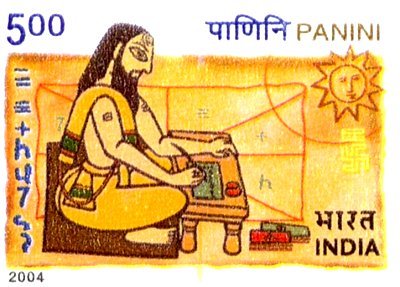
Panini (पाणिनि) must have mastered all the branches of knowledge known in his time and realized the need for a permanent set of grammatical rules which helped to absorb the ever growing language of Sanskrit. He was a great scholar who wrote down 4000 grammatical rules in aphorisms (sutra-form) describing the language of his time and arranged them in his work called Asthadhyayi (अष्टाध्यायी) by using a meta-language he himself created. This method is similar to those used nowadays in computer programming. The Asthadhyayi has been completely preserved until modern times by the teaching traditions and is considered to be an intellectual masterpiece.
The Asthadhyayi is typically studied together with the commentaries of Grammarians who explained and enriched it. To those belong Katyayana (कात्यायन), a contemporary of Panini who wrote Vartikas (additional rules) to Panini’s sutras and Patanjali (पतञ्जलि) who wrote the Great Commentary of Asthadhyayi (Mahabhasya – महाभाष्य).
Later Grammarians
The later Grammarians who wrote commentaries to the Asthadhyayi are distinguished in 2 groups: those that followed the order of sutras of Asthadhyayi – Kashikavrtti (काशिकावृत्ति) and its commentaries – and more modern who rearranged the order of the sutras for the sole purpose of facilitating the teaching – Siddhanta Kaumudi (सिद्धान्तकौमुदी) and its commentaries. There are also Grammarians who reduced the number of sutras to approximately 1200 as introduction of the student to the study of the Paninian Grammar. One of these works is called Laghu Siddhanta Kaumudi (लघुसिद्धान्तकौमुदी) by Varadaraja (वरदराज).
Show graph of streams
Sanskrit Classes Offered
Level I
Alphabet – learning the script called Devanagari (देवनागरी)
Introduction to the structure of the Sanskrit language.
This level includes writing and speaking of the Alphabet sounds and understanding how they are produced and modified inside the mouth. At the end of the course you will be able to completely read and write Sanskrit words such as ……write something
Transliteration is often used by Western Grammarians, that is writing Sanksrit words using the English alphabet. Learning how to read and write transliterated texts is of great importance not only for beginners who are not fully familiar with Devanagari but also for Academics since many advanced Western books have been written completely in transliterated form.
Give example of transliteration
The structure of the language is also introduced as preparation for the next level.
Level II
Level II – Understanding the meaning of Sanksrit sentences by learning important Grammar rules
In this level simple and more advanced texts are taught by analyzing the form of the words and the structure of the sentences. Important Grammar rules are taught, leading to an easy understanding of Sanskrit texts. These rules include Sandhi (euphonic rules), noun and verb formation and their role in a sentence.
For Vedanta students at this level we analyze texts such as Prakarana Granthas and Bhagavadgita.
Level III
Level III – Paninian Grammar – Laghu Siddhanta Kaumudi
In this level you learn the Sutras of the Asthadhyayi listed in the commentary Laghu Siddhanta Kaumudi and you apply them in texts. Learning the Grammar rules in such a compact and precise form enables clear understanding of the words and the meaning of the sentences in the texts you are studying. This is a necessary skill for Vedanta students that strive to shed light to every dark corner of their minds.
The Sutra-vrttis will be studied by means of the book “Prathamavrtti” by Brahmadatta Jijnasu, while the main course book with commentary and examples will be “Bhaimi Vyakhya” by Bhimasena Shastri. The books can be found and freely downloaded from Internet Archives.